Thursday, 30 June 2011

Isle of Wight Holiday - Day 13

East Cowes marina

Chain ferry from East Cowes to Cowes

Egypt Point, the most northerly spot on the Isle of Wight
Today was Cowes and East Cowes with a visit to the East Cowes Heritage Centre, a ride over to Cowes on the chain ferry and on to Egypt Point, the most northerly extremity of the island.

Wednesday, 29 June 2011

Isle of Wight Holiday - Day 12


High Street, Godshill village

All Saints Church, Godshill

Appuldurcombe House, near Wroxall
Another foray over towards the east to the village of Godshill, a very pretty location somewhat spoiled by hoards of trippers and the little gift shops they wander in and out of. Up on the hill stands All Saints Church surrounded by a clutch of thatched cottages which made a pleasant change to the main part of the village below. From Godshill we drove the six miles to the Isle of Wight's version of Witley Court, the ruined seventeenth-century mansion known as Appuldurcombe House near Wroxall. On the way "home" we stopped at various spots on the south coast in order to take photographs.

Isle of Wight Holiday - Day 11


Isle of Wight steam railway, Wootton

Interior of St. Mildred's Church, Wippingham

Ryde pierhead, looking towards Cowes

Former London Underground electric units work the passenger services on the IoW railway system, two of which are seen passing at Ryde St. John's Road station
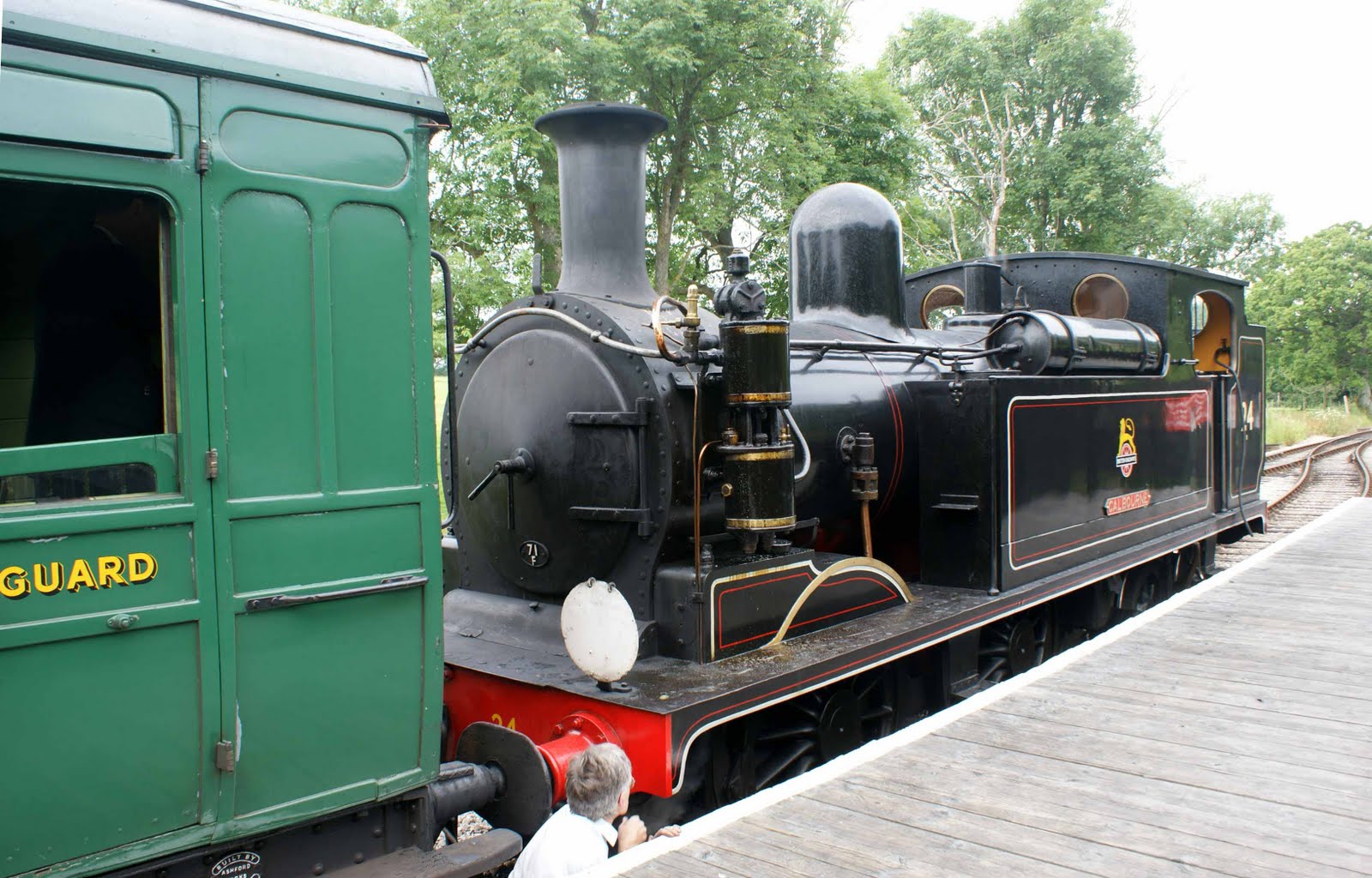
We made tracks for the east side of the island with an itinerary which included the Isle of Wight Steam Railway, St. Mildred's Church, Wippingham (where Prince Philip's grandfather is buried), East Cowes (where Norris Castle proved elusive) and then on to Ryde where Ruth and Mike went to an evening Speedway meeting, leaving me to explore the island's quirky railway system which runs from the Pierhead at Ryde down to Shanklin. It was a long day and we didn't get back until 10 p.m.

Monday, 27 June 2011

Isle of Wight Holiday - Day 10

"Farringford" near Freshwater Bay, once the residence of Poet Laureate Alfred, Lord Tennyson

"The Briary", Freshwater Bay. This house was built on the same site as that which was the residence of the artist G.F.Watts. The original property was destroyed by fire in 1934.
The morning was spent visiting Malcolm & Sue Gould, to whom we had been introduced by some of our other friends and contacts during our research activities. The Gould's live at "The Briary" near Freshwater Bay, which is a large house that was built on the site of the former residence of the artist G.F.Watts, which was  also known as The Briary, and which was destroyed by fire in 1934. Malcolm and his wife made us extremely welcome and gave us an insight into the history of the property, together with a glimpse of many old documents in his possession which were of great interest. We then went for lunch at a small restaurant adjacent to Alfred, Lord Tennyson's former residence, "Farringford" which is a private residence in this day and age.

Sunday, 26 June 2011

Isle of Wight Holiday - Day 9


At 8 o'clock in the morning it was almost impossible to see more than a few yards down the road, such was the thickness of the fog that was lapping the coastal areas of the Isle of Wight. However within an hour or so, and just a couple of miles inland, the sun burst through to give a virtually cloudless day with unbroken sunshine, warm, but with a refreshing sea-breeze, resulting in the best day of weather so far on our holiday. We drove over to East Cowes for a splendid day out at Osborne House, the former summer residence of Queen Victoria and her family. The foghorns continued to blast out out their warning until well after lunchtime, indicating that the sea-fog was still a persistent problem in the Solent.

Saturday, 25 June 2011

Isle of Wight Holiday - Day 8

Murky weather conditions surround Tennyson's monument on the high downs of the Isle of Wight

Sts. Thomas', Newport Minster, is a typical Victorian Gothick town church and was designed by the architect Samuel Whitfield Daukes, who was also responsible for Witley Court. 

The splendid ruins of Carisbrooke Castle near Newport, Isle of Wight
Fairly early in the morning Ruth and myself climbed to the top of Tennyson Down in order to watch the yachts sailing round the island in the annual Isle of Wight race. It was disappointingly misty and a stiff breeze made conditions unpleasant for both yachtsmen and spectators alike. Another disappointment followed later in the day when we arrived in Newport only to find that the Minster was closed to visitors. Nearby, the castle at Carisbrooke provided the highlight of the day, as yet again the sun broke through in the afternoon and led to a glorious evening of sunshine.

Friday, 24 June 2011

Isle of Wight Holiday - Day 7

The view from the top of St.Catherine's Hill, looking west towards The Needles over Brighstone Bay

St. Catherine's Oratory, known locally as "The Pepperpot", but resembling a medieval spaceship
St. Catherine's Oratory standing on St. Catherine's Hill is a tall medieval octagonal tower, allegedly a lighthouse, built here in 1328 by Walter de Godeton (sometimes spelled "Goditon") as penance for stealing church property from a wrecked ship. Affectionately known as the Pepperpot, it stands on one of the highest parts of the Isle of Wight. It is part of the Tennyson Heritage Coast, a series of linked cliff-top monuments. A later lighthouse can be seen nearby. From the top of the hill there are fabulous views to be enjoyed over the English Channel to the Cherbourg peninsula in northern France.